
I’ve spent a fair amount of time recently wondering how an organic bottle of Spanish wine can cost €6.
Priorat presents almost the opposite question.
Why does this bottle cost €25? Or €40? Or considerably more if you’ve wandered into the wrong part of the wine shop after payday?
Some of it, obviously, is reputation. Priorat is one of those Spanish wine names that carries weight before the cork has even come out. But dismissing the price as prestige doesn’t really work once you see where the grapes are grown.
The problem is the hill.
Actually, lots of hills.
Try Driving a Tractor Up That
Priorat is not gentle wine country.
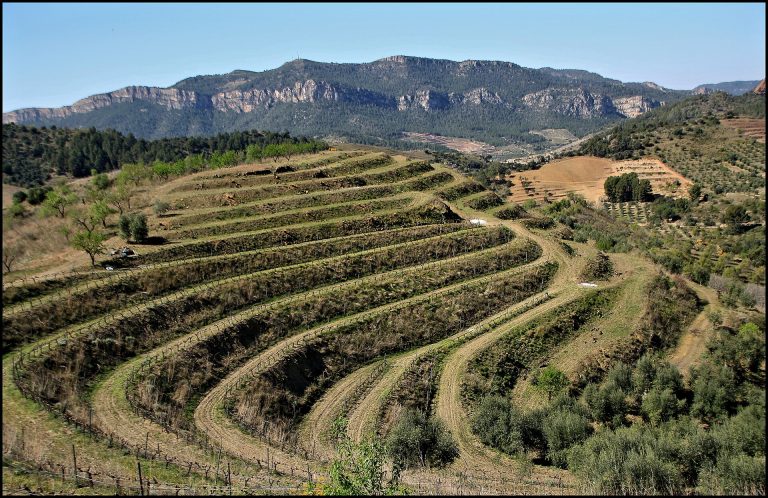
The vineyards sit among steep slopes in Tarragona, inland from the Mediterranean, and some of them look faintly ridiculous. Rows of vines cling to hillsides where you’d think twice about walking, never mind farming.
The DOQ Priorat itself says that gradients exceed 15% in most vineyards and can reach 60% in some places. On the steepest costers, machinery simply isn’t practical. Terraces help, but some are narrow enough for only a couple of rows of vines.
That means people.
People pruning. People tending vines. People harvesting grapes.
And people cost rather more than a tractor.
There is another problem if your objective is cheap wine. The vines aren’t particularly interested in producing huge quantities of grapes.
Average yields in Priorat are less than a kilogram per vine, according to the DOQ. That’s wonderful if you care about concentration and character. It’s less wonderful if you’re trying to fill supermarket shelves at €5.95 a bottle.
Suddenly the price starts making a little more sense.
Then There’s the Llicorella
You can’t read much about Priorat without encountering llicorella.
It’s the dark, fractured slate that defines much of the region. It looks inhospitable. In places it looks as though somebody decided a pile of broken roof tiles would be an excellent location for a vineyard.
Yet vines grow in it.
The roots work down through cracks looking for water, which matters in a dry Mediterranean climate. Combine that poor, stony ground with steep slopes, old vines and low rainfall and you don’t exactly have a recipe for enormous yields.
You have a recipe for struggle.
Wine people like to romanticise vines struggling. I’m occasionally guilty of it myself. The vine isn’t sitting there contemplating adversity and deciding to make a more profound bottle of Garnacha.
But difficult growing conditions do have real consequences. Less vigorous growth and low yields can mean concentrated fruit, while the differences in altitude, exposure and soil help explain why neighbouring vineyards can produce noticeably different wines.
Priorat takes that idea of place rather seriously.
Garnacha and Cariñena Are the Point
Cabernet Sauvignon, Syrah and other varieties are grown here, but the two grapes that make Priorat make sense to me are Garnacha and Cariñena, or Garnatxa and Carinyena as you’ll see them locally.
They’re the varieties the DOQ describes as Priorat’s native stars.
And this is where Priorat connects nicely with something I’ve written about before: why old vines matter in organic Spanish wine.
Old vines aren’t automatically better. That’s another wine shortcut worth being suspicious of.
But an old Garnacha or Cariñena vine that has spent decades adapting to a dry hillside is a very different agricultural proposition from a young, high-yielding vineyard designed primarily for volume.
It produces less.
It requires work.
And once an old vineyard disappears, you can’t order another one for next year’s vintage.
You wait.
Possibly for the rest of your life.
Where Organic Fits In
This is also why Priorat keeps cropping up when I write about organic wine.
I’ve previously included it among Spain’s organic wine regions and talked about the region when looking at organic and biodynamic winemaking in Spain.
It would be easy, though, to make the leap from “traditional-looking vineyard” to “organic”.
Don’t.
A vineyard being old, small, steep or worked by hand doesn’t automatically make its wine certified organic. Organic certification is something specific, not a feeling created by dusty boots and a nice photograph of a stone farmhouse.
That’s one reason I keep coming back to labels and certification rather than taking romantic wine language at face value.
If that’s what you’re trying to establish on a bottle, I’ve written separately about how to tell whether a wine is really organic in Spain.
Priorat Is Worth Exploring Properly
The slight problem with Priorat is that once you start looking beyond the famous bottles, it becomes a rabbit hole.
There are different villages, altitudes, orientations, old vineyards and producers. Porrera isn’t simply interchangeable with Gratallops because both names appear underneath the word Priorat.
If you want to go further into the region rather than just buy a bottle with PRIORAT in large letters on the label, Priorat Wine is a useful English-language site specifically devoted to the wines, villages and producers of Priorat.
That’s probably a better way to approach the region anyway.
Start with the place.
Then the producer.
Then the bottle.
Not the price tag.
So, Is Expensive Priorat Worth It?
Sometimes.
Sorry.
Wine rarely gives satisfying answers.
A €40 Priorat isn’t automatically four times as good as a €10 Spanish red. That’s not how taste works and anyone pretending otherwise probably has something expensive to sell you.
But I understand the price of Priorat much better than I understand the price of some luxury wines.
There are physical reasons for it.
Tiny yields. Difficult terrain. Vineyards that can’t simply be mechanised. Old vines that produce frustratingly little fruit. Harvests involving a great deal of human labour.
You’re paying for scarcity partly because the land creates scarcity.
That doesn’t mean every expensive bottle is brilliant.
It does mean that the next time I pick up a Priorat and wince slightly at the price, I’ll remember the hillside.
Then I’ll probably buy it anyway.